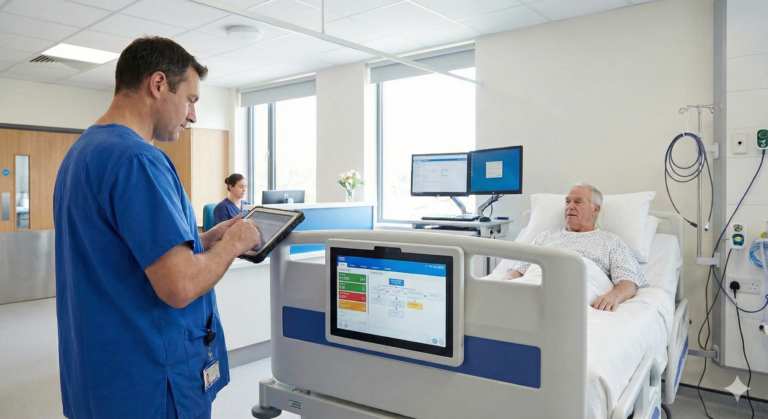
The NHS 10-Year Plan sets out an ambitious vision for digital-first care. Virtual consultations, mobile EPR access, remote patient monitoring, digital front door services, bedside patient engagement — the list is long and the direction is clear. But there is one thing every single one of these initiatives has in common, and it rarely features in the headlines.
They all need Wi-Fi to work.
Not Wi-Fi as a background utility. Not the kind that gets installed once and forgotten. Reliable, managed, healthcare-grade connectivity that works consistently across every ward, corridor, and clinical space — and keeps working.
For many NHS Trusts, that foundation simply isn’t there yet.
NHS England Has Already Said So
This is not a vendor observation. NHS England’s own Networks and Connectivity Programme exists specifically because the organisation recognises that digital transformation goals cannot be achieved without the underlying connectivity infrastructure to support them. The programme’s stated aim is to ensure NHS organisations have the required level of fixed and wireless connectivity across all sites — and its Connectivity Hub is actively working with Trusts to address gaps in coverage, share best practice, and guide infrastructure decisions.
The message is direct: poor connectivity is a barrier to digital transformation, and NHS organisations need to have a plan for it.
That is a significant statement from the centre. It means Wi-Fi is not an IT team problem. It is a board-level digital infrastructure question.
What Poor Wi-Fi Disrupts
It is easy to treat connectivity failures as minor inconveniences. In practice, the consequences are more significant.
When Wi-Fi is unreliable, mobile EPR systems drop mid-task, forcing staff to find a fixed terminal or re-enter information. Clinical staff using personal or trust-issued devices on BYOD programmes find their devices disconnecting on wards where coverage is patchy. Patient-facing applications — whether for education, consent, or communication — fail to load at the bedside. Remote monitoring data does not reach the right person at the right time.
Each of these is a friction point. Collectively, they undermine the clinical workflows and digital services that Trusts have invested heavily in building — not because the systems themselves are flawed, but because the network underneath them cannot keep up.
The NHS 10-Year Plan’s ambitions for digitally enabled care will remain aspirational in environments where the connectivity is not fit for purpose.
What a Managed Wi-Fi Service Looks Like
There is an important distinction between Wi-Fi connectivity and a properly managed Wi-Fi service. Most Trusts have the former. The latter is meaningfully different.
A managed service begins with understanding what a Trust actually needs. Requirements are gathered across IT, estates, and clinical teams — covering user volumes, access requirements, existing infrastructure, and how the network needs to perform for different user groups. From there, a portal is configured and deployed to sit on top of the Trust’s existing network, tailored to the hospital’s branding and digital services.
The patient-facing experience is designed to be simple. A single SSID covers all user groups — staff authenticate using their NHS email credentials for rolling long-term access, while patients and visitors connect quickly and without barriers. There is no need to navigate multiple networks or explain different access routes to patients who are already stressed and unwell.
Beyond go-live, the service runs continuously and actively. Real-time analytics give Trust teams direct visibility over usage patterns, connected device types, and network performance — all accessible via a self-service management platform, without needing to raise a request with the supplier to pull a report. Regular account management reviews keep service provision, uptime, and contractual KPIs under ongoing scrutiny. And 24/7 technical support means that when something goes wrong, it is resolved quickly rather than waiting for the next business day.
This is a service that is maintained, monitored, and accountable — not configured once and left to run.
Wi-Fi as a Patient Engagement Platform
Getting connectivity right has implications beyond clinical workflows. Once patients are connected, the network becomes the gateway to every digital service the hospital wants to put in front of them.
A well-designed patient portal — branded to the hospital, built in collaboration with the communications team — can deliver ward information, education content, patient surveys, and more, all from the moment a patient connects. Content is flexible, updateable, and tailored to the hospital’s specific needs. The same infrastructure that keeps a nurse’s device connected is also the platform through which patient engagement, experience, and outcomes data can be gathered — all without additional hardware or separate systems.
Digital signage, patient entertainment systems, and bedside technology all sit on the same network. When the Wi-Fi is right, everything else works better.
Procurement Does Not Have to Be Complicated
One reason Wi-Fi upgrades stall in NHS procurement pipelines is the perceived complexity of getting a project through the approvals process. It is worth noting that managed Wi-Fi services are available through the G-Cloud 14 framework — a Crown Commercial Service procurement route specifically designed to simplify public sector technology purchasing. For Trusts that need a compliant, audit-ready route to market, it is already there.
The Practical Next Step
If your Trust is planning digital investment — whether in EPR, patient engagement, remote monitoring, or any of the other priorities set out in the 10-Year Plan — it is worth asking a simple question: does the Wi-Fi underneath all of it actually work well enough to support it?
For many sites, the honest answer is uncertain. A site survey is the fastest way to find out where coverage gaps exist, what the infrastructure can and cannot support, and what a realistic upgrade path looks like.
If you would like to understand what a managed service could look like for your Trust, we would be happy to talk.
Get in Touch with Airwave Healthcare
If you’re exploring digitally enabled care in your organisation, we’re happy to share practical insight from frontline NHS deployments. You can contact our team at connect@hospitaltv.co.uk or arrange a short introductory call at a time that suits you.