A shift in what “digital” really means
For much of the past decade, “digital first” has been shorthand for progress in the NHS. It has signalled modernisation, innovation and a desire to move services away from paper-based processes and legacy systems.
That ambition remains. But the context has changed.
The NHS 10-Year Health Plan reflects a system under sustained operational pressure — where the question is no longer what digital could enable in the future, but what digital must reliably support today.
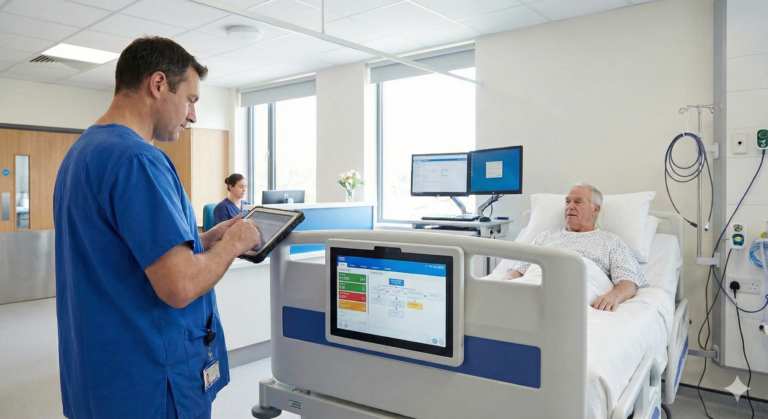
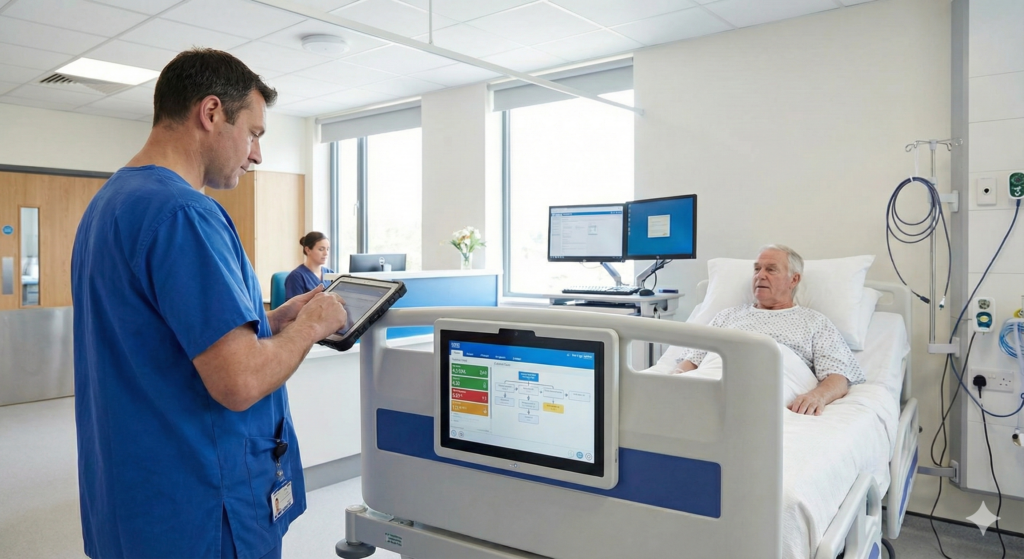
In this environment, infrastructure, connectivity and bedside technology are no longer supporting actors. They are becoming part of the care environment itself.
Why “fixing the basics” has become a national priority
The renewed focus on foundations is rooted in hard reality. Lord Darzi’s independent investigation into NHS performance identified chronic capital underinvestment as a major contributor to falling productivity, despite significant growth in the workforce.
Outdated devices, fragmented systems and unreliable connectivity create friction at every stage of care delivery. This accumulation of digital debt does not simply slow progress — it actively consumes clinical time and increases administrative burden.
For Trust leaders, “fixing the basics” now matters because:
- Slow or unreliable systems waste clinical time before care even begins
- Fragmented digital estates increase duplication and error risk
- Poor connectivity undermines bedside, mobile and community workflows
- Digital friction directly affects productivity, flow and staff morale
The priority is not innovation for its own sake, but restoring reliability so staff can focus on care rather than systems.
Infrastructure as part of the care environment
One of the clearest signals in the plan is the repositioning of digital infrastructure as a clinical enabler.
As care models increasingly depend on mobile working, real-time data and virtual pathways, reliable connectivity becomes essential. A failure of Wi-Fi or access is no longer a minor inconvenience; it can delay discharge, interrupt ward workflows or prevent clinicians from accessing records at the point of care.
This is reflected in national initiatives such as the Networks and Connectivity transformation programme , which focuses on improving coverage, enabling roaming across sites and supporting care beyond the hospital estate.
Infrastructure no longer sits in the background. It underpins digitally enabled care.
Why bedside technology has moved from comfort to critical
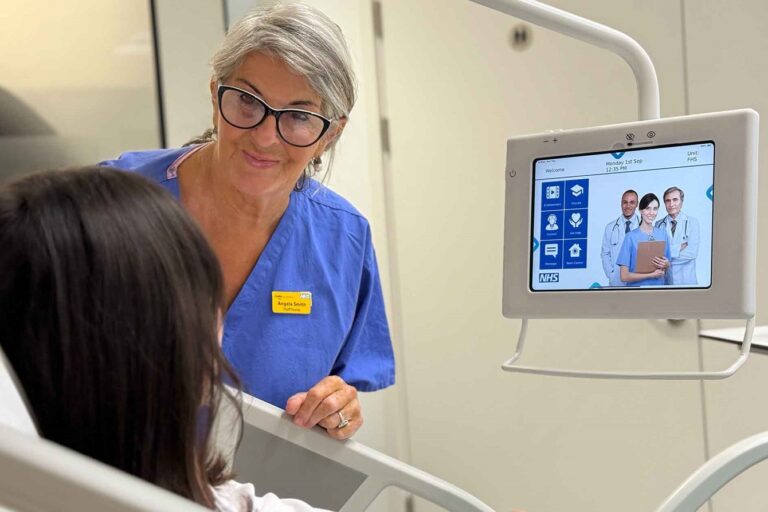
Historically, bedside systems were associated primarily with entertainment or comfort. Today, they are increasingly linked to coordination, communication and operational visibility — particularly as Trusts work to improve patient flow.
Discharge delay remains one of the most persistent pressures on the system. Evidence shows that early discharge planning as a day-one priority is critical to reducing length of stay and improving flow.
In practice, bedside and ward-level technology supports:
- Clearer communication with patients and families
- Better coordination across multidisciplinary teams
- Reduced administrative friction at critical points in the pathway
Bedside technology is no longer peripheral. It plays a role in how effectively wards function day to day.
What “digitally dependable” looks like in practice
The move towards dependability does not mean lowering ambition.
It means
raising expectations of reliability.
Trusts are increasingly cautious about standalone tools, pilot projects or consumer-grade solutions that struggle to operate at scale.
Instead, priority is given to systems that:
- Integrate cleanly with core NHS records
- Function reliably in busy clinical environments
- Reduce cognitive load rather than add complexity for staff
The NHS 10-Year Plan reinforces this through its focus on interoperability and the development of a Single Patient Record.
What Trusts are likely to prioritise between 2025 and 2027
Taken together, the signals from national policy and frontline experience point to a clear set of near-term priorities.
Trusts are most likely to focus on:
- Infrastructure refresh, including devices, Wi-Fi and connectivity
- Bedside and ward-level capability that supports flow and discharge
- Technology with clear, demonstrable operational impact
In this environment, digital investment is judged less on novelty and more on whether it works — consistently and at scale.
Dependability before transformation
The NHS is not stepping away from digital ambition. But the 10-Year Plan signals a more mature phase, grounded in delivery reality.
Infrastructure, connectivity and bedside technology are now essential to digitally enabled care, not optional foundations to be addressed later.
Being digitally dependable is no longer a nice-to-have. It is a prerequisite for recovery, resilience and effective care delivery across the NHS.
Get in Touch with Airwave Healthcare
If you’re exploring digitally enabled care in your organisation, we’re happy to share practical insight from frontline NHS deployments. You can contact our team at connect@hospitaltv.co.uk or arrange a short introductory call at a time that suits you.